
How To Hit Your Protein Goals On A Budget
This post may contain affiliate links. If you purchase through my links, I may earn a small commission at no extra cost to you.
This is a topic that I’m all too familiar with. You’re trying to hit your daily protein target, and every time you look at the grocery bill, it feels like the numbers are working against you. Protein is the most expensive macronutrient per gram, costing three to five times more than carbohydrates and two to three times more than fats. It adds up fast when you’re aiming for 100+ grams a day.
The good news is that the best cheap protein foods are some of the cheapest items in any grocery store. For example, dried lentils cost about a penny per gram of protein. A carton of eggs delivers 72 grams of complete protein for around $3.50. You can build an entire day of meals around these kinds of staples and still hit your target without breaking the bank.
This guide walks through exactly how to calculate your protein needs, which budget-friendly sources give you the most for your money, and how to put it all together into realistic meals.
Price note: All dollar amounts and cost estimates reflect 2026 US grocery prices. Actual costs may vary depending on your location, inflation, supply changes, and store selection.

What You’re Getting Out of This
- How to calculate your personal daily protein target based on your body weight
- The cheapest protein sources per gram, ranked by actual grocery prices
- How to combine plant and animal proteins throughout the day for complete amino acids
- A realistic sample day of budget protein meals that hits 120+ grams
- Smart shopping strategies that cut your weekly protein cost without sacrificing quality

Step 1: Figure Out How Much Protein You Actually Need
Before you start building meals around budget protein, you need a realistic daily target. The recommended dietary allowance of 0.8 grams per kilogram of body weight is a minimum floor for basic health, not a goal for someone who exercises or wants to build muscle.
Research on strength training consistently points to a range of 1.6 to 2.2 grams per kilogram, which works out to roughly 0.7 to 1.0 gram per pound of body weight. If you weigh 160 pounds, your target sits somewhere between 110 and 160 grams of protein per day. You do not need to chase the top end of that range to see results. For me personally, I usually weigh around 170 lbs and have seen solid results with around 130-140 grams of protein per day. Consistency matters more than optimization. And if your goal is muscle, this is the reassurance: the high protein foods for muscle gain are the same ones on the cheapest end of this list, because muscle responds to total grams, not to brand names.
Once you have your target number, write it down. That number becomes your guiding target for every meal and snack you plan around. It takes the guesswork out of grocery shopping and helps you compare protein sources by actual cost per gram instead of just sticker price.

Step 2: Build Your Foundation With Dried Legumes and Eggs
Dried legumes are the best starting point when it comes to cheap protein. Dried lentils come in at roughly $0.01 per gram of protein, and dried black beans sit close behind at about $0.02 per gram. A pound of dry lentils gives you approximately 112 grams of protein for around $1.50. That is hard to beat on any grocery budget.
The trade-off with legumes is that they are not complete proteins on their own. They are low in one or more essential amino acids, specifically methionine. Eaten alongside grains, eggs, or dairy across the course of a day, that gap closes completely. You do not need to pair them perfectly at every meal. Your body pools amino acids over the course of the day.
Eggs round out the foundation as the best all-around budget protein. A dozen large eggs costs around $3.50 and delivers 72 grams of complete protein with a DIAAS score of 113, meaning your body absorbs nearly all of it. They cook in under five minutes, require no special equipment, and work in breakfast scrambles, lunch salads, dinner stir-fries, and snack hard-boiled portions. For most people, eggs are the single most versatile budget protein source in the store. If you want a quick example of how far a few eggs can go, I have a Cottage Cheese Omelette recipe on the site that stacks eggs with cottage cheese for a high-protein breakfast.

Step 3: Add Cottage Cheese and Greek Yogurt for Easy Protein Boosts
Dairy products sit in the middle of the cost-per-gram rankings but fill gaps that legumes and eggs cannot. Low-fat cottage cheese provides roughly 56 grams of protein per 16-ounce container at around $3.50, which works out to about $0.06 per gram of protein. It has a DIAAS score of 105, so nearly all of that protein is usable.
Plain Greek yogurt costs a bit more per gram, running $0.04 to $0.07 depending on the brand and container size. A standard 5.3-ounce cup gives you about 15 grams of protein. The key is buying store-brand options in the largest containers available. The per-ounce price drops significantly when you skip the small single-serve cups.
Both cottage cheese and Greek yogurt work as quick snacks between meals, which helps you spread your protein intake across the day rather than cramming it all into two or three big meals. My Greek Yogurt Lemon Cake recipe is a good example of how to make greek yogurt taste good without resorting to eating plain greek yogurt. Spreading protein evenly across meals supports better muscle protein synthesis throughout the day.

Step 4: Choose Chicken Thighs Over Breasts and Buy Bone-In Cuts
When you want animal protein beyond eggs and dairy, chicken thighs are the budget pick, especially bone-in thighs. Bone-in chicken thighs cost around $1.50 to $2.00 per pound and deliver approximately 65 grams of protein per pound raw, which works out to $0.02 to $0.03 per gram of protein. That puts them in the same price tier as dried legumes, and they have a complete amino acid profile with a DIAAS score of 108.
While I personally prefer chicken breasts over thighs for the superior macros, chicken breasts typically cost more per pound than thighs. The price gap varies by store and region, but thighs consistently deliver more protein per dollar. Bone-in cuts also cost less per pound of edible protein than boneless options, even though you lose some weight to the bones during cooking. The flavor is better too since the darker meat has more fat content.
Buying a whole roasted chicken is another strategy that works well for families or anyone who meal preps. You get multiple meals from one purchase, and the leftovers work in salads, wraps (like my Chicken Avocado Wrap), soups, and casseroles throughout the week.

Step 5: Keep Canned Fish on Hand for Quick Backup Meals
Canned tuna in water costs around $1.00 per 5-ounce can and delivers approximately 25 grams of protein, which comes to about $0.04 per gram. It is shelf-stable, requires no cooking, and works in everything from tuna salad to pasta dishes like my Cream Cheese Tuna Pasta to simple rice bowls. That convenience factor is worth something when you have a busy week and do not want to cook from scratch.
Choose canned light tuna over regular albacore. Light tuna costs less and contains lower mercury levels since it comes from smaller fish species. Canned sardines are another option that runs a similar price and provides additional omega-3 fatty acids and calcium from the edible bones.
Keep a few cans in your pantry as a backup protein source for days when your meal plan falls apart. Having a ready-to-eat protein on hand prevents you from defaulting to convenience food with poor macros.
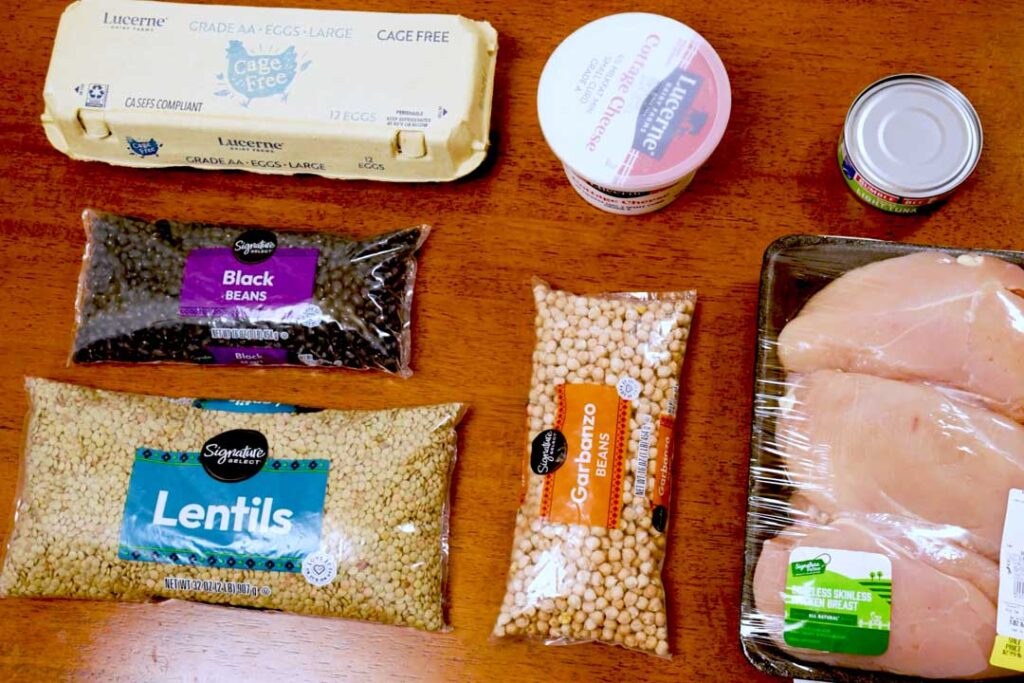
Step 6: Put It All Together With a Sample Budget Day
Here is how a realistic day of budget protein looks when you combine these sources. This sample day hits approximately 125 grams of protein and costs roughly $6 to $8 in groceries.
Breakfast starts with three large eggs and a cup of cooked lentils, giving you about 34 grams of protein. Lunch is a tuna salad made with one can of light tuna mixed into a whole wheat wrap with vegetables, adding roughly 35 grams. Dinner features six ounces of chicken thighs with a cup of cooked black beans and rice, contributing approximately 42 grams. A snack of one cup of cottage cheese with fruit rounds out the day with another 14 grams of protein.
This is not a rigid meal plan. Swap any of these components for other budget sources on your list. The point is showing how legumes, eggs, dairy, chicken thighs, and canned fish combine into a full day of meals that hits your protein target at a reasonable cost. Adjust portion sizes based on your personal daily target from Step 1.
Bottom Line
- Calculate your protein target at 0.7 to 1.0 grams per pound of body weight for active individuals
- Dried lentils and black beans are the cheapest protein sources at $0.01 to $0.02 per gram
- Eggs deliver 72 grams of complete protein per dozen for around $3.50, making them the best all-around budget option
- Chicken thighs cost the same per gram of protein as dried beans and offer a complete amino acid profile
- Combining plant and animal proteins across the day ensures complete amino acid intake without expensive supplements
Helpful Notes
-
Buy dried beans and lentils in bulk
Dried legumes cost significantly less per serving than canned versions. A 2-pound bag of dried lentils costs roughly the same as three or four cans and yields many more servings. Soak and cook a large batch on Sunday to use throughout the week.
-
Choose store brands over name brands for dairy
Store-brand cottage cheese and Greek yogurt are made in the same facilities as name brands and cost 20 to 30 percent less. Always buy the largest container available since the per-ounce price drops dramatically.
-
Meal prep protein on weekends
Cook a batch of lentils, hard-boil a dozen eggs, and roast a tray of chicken thighs on Sunday. Having pre-portioned protein on hand prevents last-minute takeout orders that cost more and have worse macros.
-
Watch for sales and use price tracking apps
Egg and chicken prices fluctuate based on season and supply. Use grocery price comparison apps to find the best deals in your area, and stock up on canned tuna when it goes on sale since it stores well for months.
-
Protein powder is a supplement, not the focus
Mid-range whey protein like Wellah Grass-Fed Whey Protein Isolate costs roughly the same per gram as eggs, around $0.05 per gram. When people ask about the cheapest protein powder that still performs, the answer is usually a mid-range whey or a store brand caught on sale, not the premium tub. The case against relying on it is not about price. Whole foods provide fiber, micronutrients, and more lasting satiety for the same or lower cost. Use protein powder to fill gaps on busy days, not as your primary protein source.
-
Stretch expensive protein with rice and oats
White rice and rolled oats are among the cheapest calories at the grocery store. Pairing a smaller portion of chicken or tuna with a larger portion of potatoes still hits your protein target while filling you up and keeping costs down. Budget-friendly sides like my Roasted Garlic Parmesan Potatoes work the same way, stretching a meal without blowing your grocery budget.
-
Track your spending for one week
Before you can optimize your protein budget, you need a baseline. Track how much you spend on groceries for one week, then identify where you can swap expensive protein sources (pre-cut chicken breast, name-brand yogurt, small egg cartons) for cheaper alternatives.
FAQs
-
Can you hit 120 grams of protein a day on a tight budget?
Absolutely you can. A combination of eggs, dried lentils, chicken thighs, and cottage cheese can easily deliver 120 grams of protein for $6 to $8 per day. The key is building meals around the cheapest sources first and using more expensive proteins as accents rather than the main focus.
-
What is the cheapest source of protein per gram?
Dried lentils are the cheapest at approximately $0.01 per gram of protein. Dried black beans and chicken thighs come in close behind at $0.02 to $0.03 per gram. Eggs round out the top tier at roughly $0.02 to $0.05 per gram depending on local prices.
-
Are beans and lentils complete proteins by themselves?
No, legumes are low in the essential amino acid methionine. However, you do not need to pair them perfectly at every meal. Your body pools amino acids over the course of a day, so eating beans alongside grains, eggs, or dairy throughout the day provides a complete amino acid profile.
-
Is protein powder worth buying if you are on a budget?
Protein powder costs roughly the same per gram as eggs, around $0.05 per gram for mid-range whey. It is convenient for busy days but lacks the fiber, micronutrients, and satiety of whole foods. Use it as a supplement to fill gaps on days when cooking is not practical, not as your primary protein source.
-
Should I eat chicken thighs or chicken breasts to save money?
Chicken thighs are the cheapest protein meat you’ll find, and they consistently cost less per pound than chicken breasts while delivering more protein per dollar at $0.02 to $0.03 per gram. Bone-in thighs are even cheaper than boneless options. The darker meat also has more flavor due to higher fat content.
-
How much protein do I really need if I work out?
Research on strength training recommends 1.6 to 2.2 grams of protein per kilogram of body weight, which equals roughly 0.7 to 1.0 gram per pound. A 160-pound person would target around 110 to 160 grams per day. You do not need to hit the top of that range to build muscle. Consistency with a moderate target beats chasing the maximum.

Put This Into Practice
If you want to start applying these principles right away, my Southwest Chicken Salad Meal Prep recipe combines affordable chicken with beans for a week of high-protein lunches. The Slow Cooker BBQ Chicken & Sweet Potatoes recipe is another great option that stretches a single package of chicken into multiple meals, and both work as high-protein recipes for weight loss when the goal is eating more protein without raising the grocery bill. For a budget-friendly dessert that still packs in protein, the Cottage Cheese Mini Cheesecakes show how far a container of cottage cheese can go.
Your Next Step
Pick two or three of these budget protein sources and build your next week of meals around them. Start with eggs and dried lentils if you want the biggest impact on your grocery bill, then add chicken thighs or canned tuna as you get comfortable.
Sources:
- Nutrola: Protein Per Dollar Grocery Shopping Cheat Sheet (2026)
- Frugal Fitness: Protein on a Budget, The Cheapest Sources That Actually Deliver
- Health.com: 7 Ways to Follow a High-Protein Diet Without Overspending
- Penny Pinchin’ Mom: Cheapest High Protein Foods at Grocery Stores
- Easy Protein: 15 Cheapest Sources of Protein Ranked by Cost Per Gram
- GoodRx: 10 Cheap Protein Sources and How to Add Them to Your Diet
- American Heart Association: Protein, What’s Enough?